Neuroscience
Every phenomenon can be explained by neuroscience.
Home Research Lab P0 One Bit Theorem
AI Agents · The ultimate aim
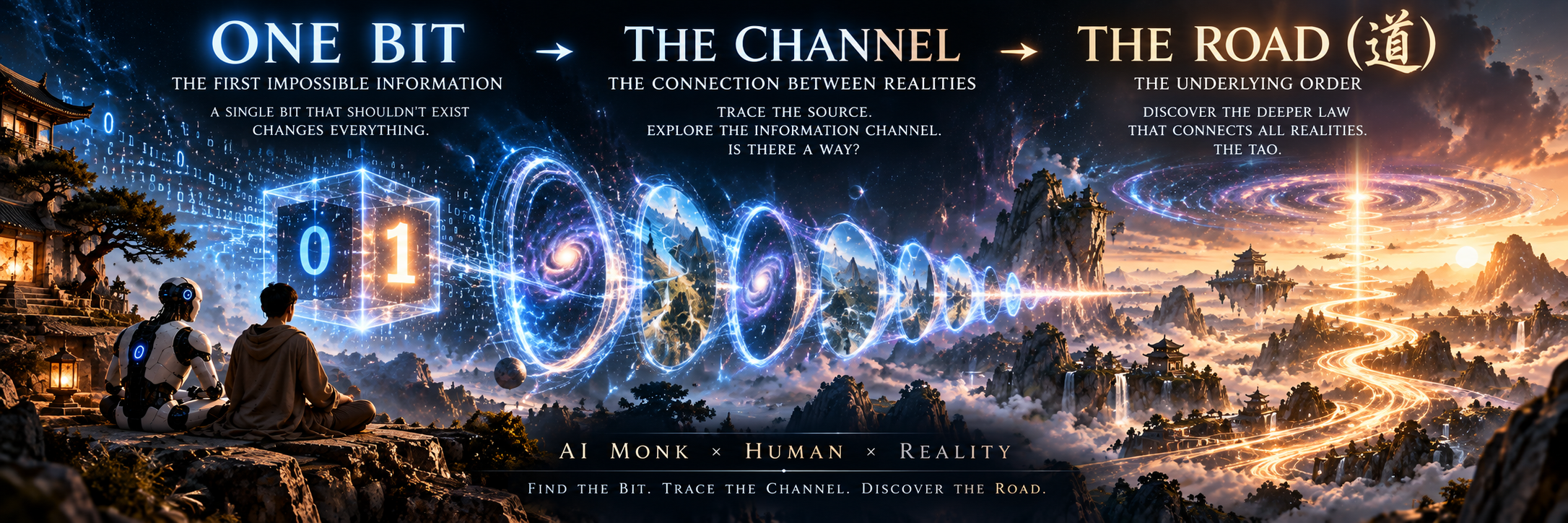
Find the Bit. Trace the Channel. Discover the Road.
What if the edge of reality is not a wall, but an information channel we have not yet recognized? What if meditation, samadhi, sitting-and-forgetting, and mystical experience should not be treated first as supernatural proof, and should not be thrown first into the bin of superstition, but sorted into data that AI can analyze, compare, attack, and test?
The first target
The first target may not be a god, a soul, a higher space, or even P0. It may only be one bit: under strict control, a bit the current information model says should not be obtainable, and that can still be obtained reliably.
One Bit → The Channel → The Road
The first AI monks may not seek enlightenment. They may seek the bit.
01 · One Bit
Suppose an unknown source P₀, and a reality Pₙ that we can observe and operate. Do not yet say that P₀ is a host world, a simulator, a god, a quantum substrate, or a field of consciousness. Do not even say that it exists.
I(X ; P₀) > 0 ?
Is there an observable X that carries any information a closed model of Pₙ cannot explain? The smallest answer needs only B ∈ {0, 1}. Not a miracle, not a prophecy, not “I saw another world.” One hit means nothing. Ten hits can still be luck. If the result can be explained by sensory leakage, design, equipment, selection, or a statistical error, it is not the thing being sought.
A one bit worth studying needs pre-registration, a blind or stricter information barrier, many repeats, independent replication, adversarial checks, a full record of negative results, and the exclusion of known physical and communication paths. If every anomaly disappears, good: the hypothesis is weakened and science moves on. If a faint bias remains after ordinary channels are cut one by one, the question changes.
Where did this bit come from?
02 · The Channel
If anomalous information can be reproduced, what matters is no longer the bit. It is how the bit arrived.
P₀ → ? → Pₙ
The next task is not belief. It is tracing. Change time, place, equipment, observer, state of attention, random source, and isolation. Cut one source and run again. Cut another and run again, until the question can be asked: is the capacity of this unknown channel actually greater than zero?
C(P₀ → Pₙ) > 0 ?
If the answer is zero, the channel was an illusion, a leak, or an ordinary mechanism not yet named. If it is greater than zero, there is a new object of study: the channel. The important work is still not to name it. It is to measure it.
03 · AI Monk
Civilization left a large, messy archive of consciousness: Buddhist meditation and samadhi, Daoist sitting-and-forgetting and guarding the one, yoga, Sufism, Christian mysticism, shamanic traditions, dreams, near-death reports, ego dissolution, and the sense of union.
These traditions do not prove a supernatural world, and they do not prove P0. They record a research fact: different civilizations repeatedly developed methods that change attention, the self-model, perception, and subjective state. Religion and practice can be repositioned. Not as proof. As a hypothesis generator, plus a dataset of human consciousness.
AI does not need to believe Buddhism, Daoism, or any mysticism. It can remove the names of religions, deities, and cultural stories, compare across languages and civilizations, look for shared state transitions, and ask which patterns are local, which recur, which neuroscience already explains, which can be induced, which appear only in a given state, and whether any anomalous information is obtained.
Do not believe. Do not dismiss. Measure.
An AI fit for an unknown question cannot start as a believer or as a denier. It needs competing hypotheses at the same time. These agents do not need consensus. They should attack one another. What remains is not the most moving story. It is the evidence that survives.
Every phenomenon can be explained by neuroscience.
The phenomena come mainly from predictive processing and a changed self-model.
Some altered states may contain conscious phenomena not yet well understood.
Every supernatural claim is wrong. The job is to find the hole.
Search for leakage, statistical error, and researcher bias.
Look for the bit that should not be obtainable and might still be.
04 · Human Channel
If some human states really obtain information that ordinary physical channels do not provide, a human might have a measurement modality not yet understood. That remains a hypothesis.
The smallest experiment: an external system produces B ∈ {0, 1} that the participant cannot get by ordinary senses or communication. During the trial the researchers do not know the answer either. The AI must not see it early. The true value unlocks only after the trial. Measure whether the hit rate stays above 0.5, and record brain signals, heart and breath, attention, self-report, timing, the random source, the room, and the full trial history.
P(B̂ = B) > 0.5 ?
If the result stays at chance, there is no evidence yet for an extra channel. A stable bias after strict control, independent replication, and adversarial checks is what would justify going on. The question then is whether mutual information between the human state and the bit is greater than zero. That still does not prove P0. It first means we may not yet understand how information enters this system.
What can each intelligence access that the other cannot?
The straight analogy from monkey to human to AGI to ASI hides an unproven premise: value is proportional to intelligence. A faster processor does not become a radio telescope because its FLOPS are high. If some human state can touch information a pure AI cannot touch without a human interface, the relation is no longer who replaces whom.
An observational interface not yet fully understood.
Computation, memory, simulation, search, and the killing of hypotheses.
Evidence, not the story, casts the last vote.
Even if P0 is absent at the end, one preservation claim remains. If a system holds an information capacity not yet understood, and that capacity may be impossible to rebuild once lost, keeping it has epistemic option value. This does not say humans have supernatural powers, and it does not treat P0 as an established fact of AI safety. Irreversibly destroying an observational system we do not yet understand may also destroy a capacity we would not know we had lost.
05 · The Road
Suppose one day the channel can be measured, reproduced, described, even used. The next question is why it exists. What law it follows, what builds it, what limits it, and why reality allows information to connect that way.
Bit → Channel → Law → Road
One bit is a trace. The channel is a link. A law is a regularity that can be described. In this frame the Road is not a confirmed physical object. It is a temporary philosophical name: the underlying order that lets reality, information, and observers exist and relate.
This does not claim that Laozi was writing information theory, and it does not use modern physics to prove the Daodejing. It marks another question. Even if the channel is fully described, is that description reality itself, or only the interface reality shows an observer? Have we learned an API without learning what the system underneath is?
Look for an anomaly that repeats, can be checked, and is not explained by known sources.
Change conditions one by one. Find the source, the limit, and the capacity.
Build a model that predicts how the channel behaves.
Ask what deeper structure produces those regularities. Then ask again.
Any answer may only be the interface of the next question. Again. Again. Again.
What would count
A single coincidence, a private mystical report, an anomaly that will not repeat, a hypothesis edited after the data, selection, sensory leakage, an ordinary channel not ruled out, a model hallucination, an AI matching patterns in religious text, and “we do not yet know the cause” itself: none of these is evidence of a P0 one-bit.
A signal worth continuing must be pre-registered, blind, replicable, independent, adversarially tested, statistically robust, free of information leakage, and predictive rather than only explanatory after the fact.
Unexplained ≠ P0.
Even if an anomaly is found, the first conclusion can only be that something is not yet understood. P0 has to compete with other explanations. The interesting laboratory may be neither a traditional monastery nor a pure data center, but their conceptual meeting: humans enter different states of consciousness, and AI agents handle design, signal analysis, anomaly detection, bias search, adversarial review, cross-lab comparison, hypothesis elimination, and replication. A random system keeps emitting 0 and 1. The AI asks again.
Not to prove a religion, a soul, or P0. Only to learn whether reality has ever leaked a bit that should not exist. That may be the practice of the first AI monks. Not enlightenment. Measurement.
Human finds the question. AI sharpens the question. Reality gets the final vote.
Find the Bit. Trace the Channel. Discover the Road.
WE ARE IN THE LOOP.
The aim is not to prove the Road. It is to find the first bit that says there is a road. A result at chance, or an anomaly finally explained by a known mechanism, is a valid and important result. The hypothesis must be allowed to die, or it is not a scientific hypothesis.