Undecidable questions
No algorithm returns yes or no for every input. Another binary query does not guarantee convergence to an answer.
Home Research Lab P0 One Bit Theorem
P0 One Bit Theory · Extension
P0 One Bit Theory is not yet an answer key for every question. The hypothesis worth studying is whether it can become a key that turns different questions into the same kind of question.
Not the answer
Write any question as a set of hypotheses still waiting to be distinguished. Each useful bit cuts the space of possible worlds, until the uncertainty approaches zero.
Q → {H₁, H₂, …, Hₙ}
Iₜ₊₁ = Iₜ + ΔI
In the ideal case, one binary observation bₜ ∈ {0, 1} keeps cutting the hypothesis space:
Until H(Ωₙ) → 0. At that point one bit is not the answer itself. It is a conversion:
Question → Binary Distinction → Information Gain → State Reduction → Answer
Can every solvable question be reduced to a finite or convergent sequence of informative binary distinctions?
If that holds for some strictly defined class of questions, mathematical proof, experiment, AI reasoning, Bayesian inference, search, diagnosis, decision, and even physical measurement could sit inside one abstract frame. The next step is not a larger story. It is to attack the claim.
Pressure test
The question worth asking now is not how much it can explain. It is what the one-bit principle cannot reach.
No algorithm returns yes or no for every input. Another binary query does not guarantee convergence to an answer.
The question can be stated, but no effective procedure computes the result in a finite number of steps.
However the observations are cut, the one fact needed to separate the hypotheses is still missing.
Every Yes/No carries information, but the sequence does not approach a decidable end.
∃ Q : P₀(Q) ↛ Answer ?
Only if One Bit Theory can still draw a clear boundary in front of these counterexamples is there a reason to move it from a tidy unifying view toward a theory. Finding that wall is the first time its size becomes visible.
Three benchmarks
Ask whether it can produce a derivation that is more useful than current physics, and that can be refuted. Rewrite all three questions first as “the smallest missing information.”
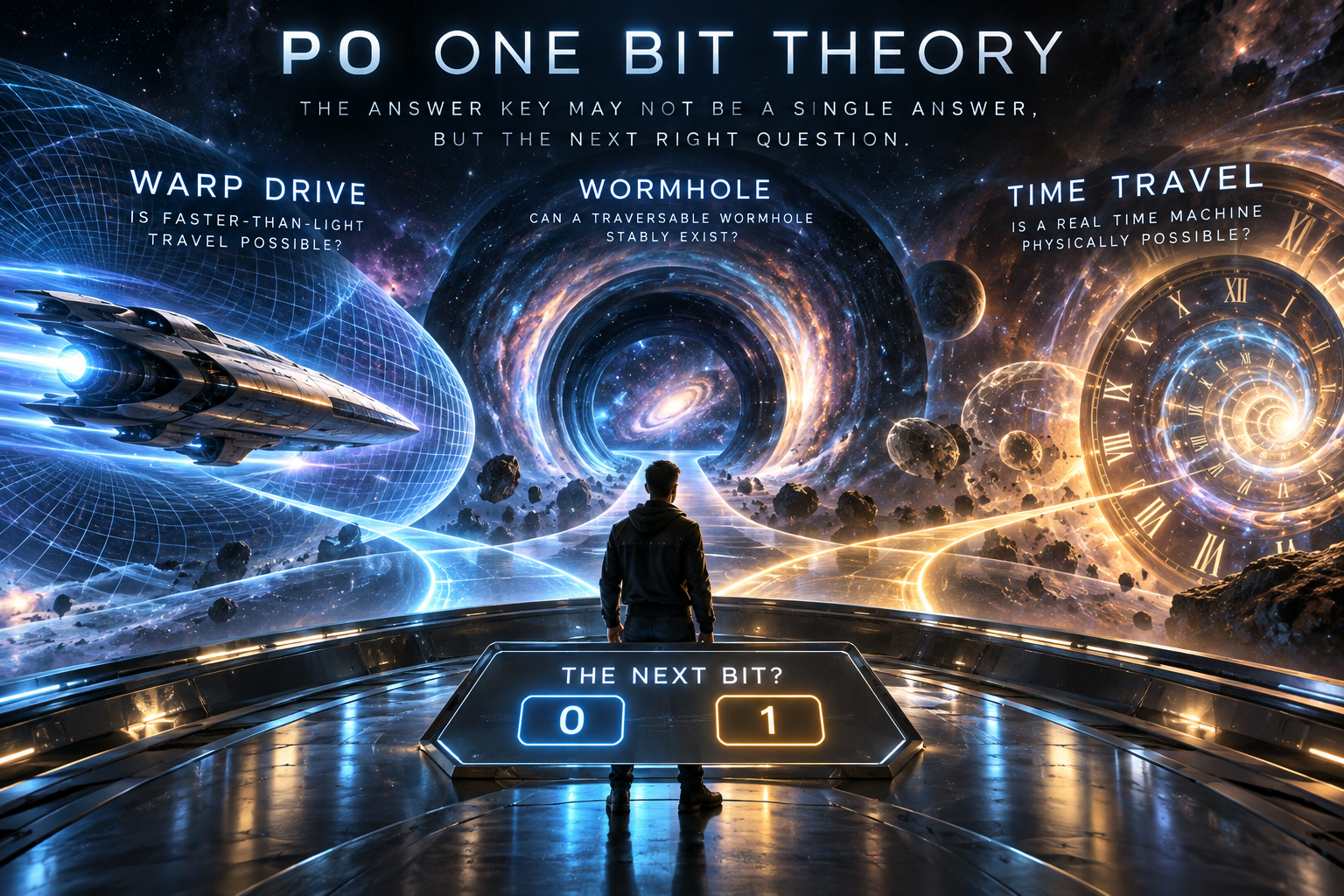
Which unknown bit, once fixed, would decide whether effective faster-than-light displacement has a physically open path?
Which bit decides whether a traversable wormhole can remain stable under real quantum-gravity conditions?
Which bit decides whether a closed timelike curve can be physical, rather than only a mathematical solution allowed by general relativity?
∀ Q, Q → B*(Q) → Experiment → {0, 1} → Q′
B*(Q) is the bit with the largest information gain for that question. P0 does not need to say how to build a warp engine. It should first answer: among everything humans do not yet know, what is the next 1 bit most worth knowing?
Obtain it, then compute the next one: b₁ → b₂ → b₃ → ⋯
Science = Optimal sequence of questions
Discovery ≈ arg maxb I(b ; Q)
If the universe lets me know only one more Yes/No fact, which question should I ask?
If the method works, the real answer key is not a hidden answer. It is an algorithm for finding the next right question. Warp drive, wormholes, and time travel can serve as three limit benchmarks.
Warp drive, as a method test
Do not start with “how do you build a warp drive?” That question mixes spacetime geometry, energy conditions, quantum field theory, causality, and engineering scale at once. P0 asks only: if you may take 1 bit, where should the new information go?
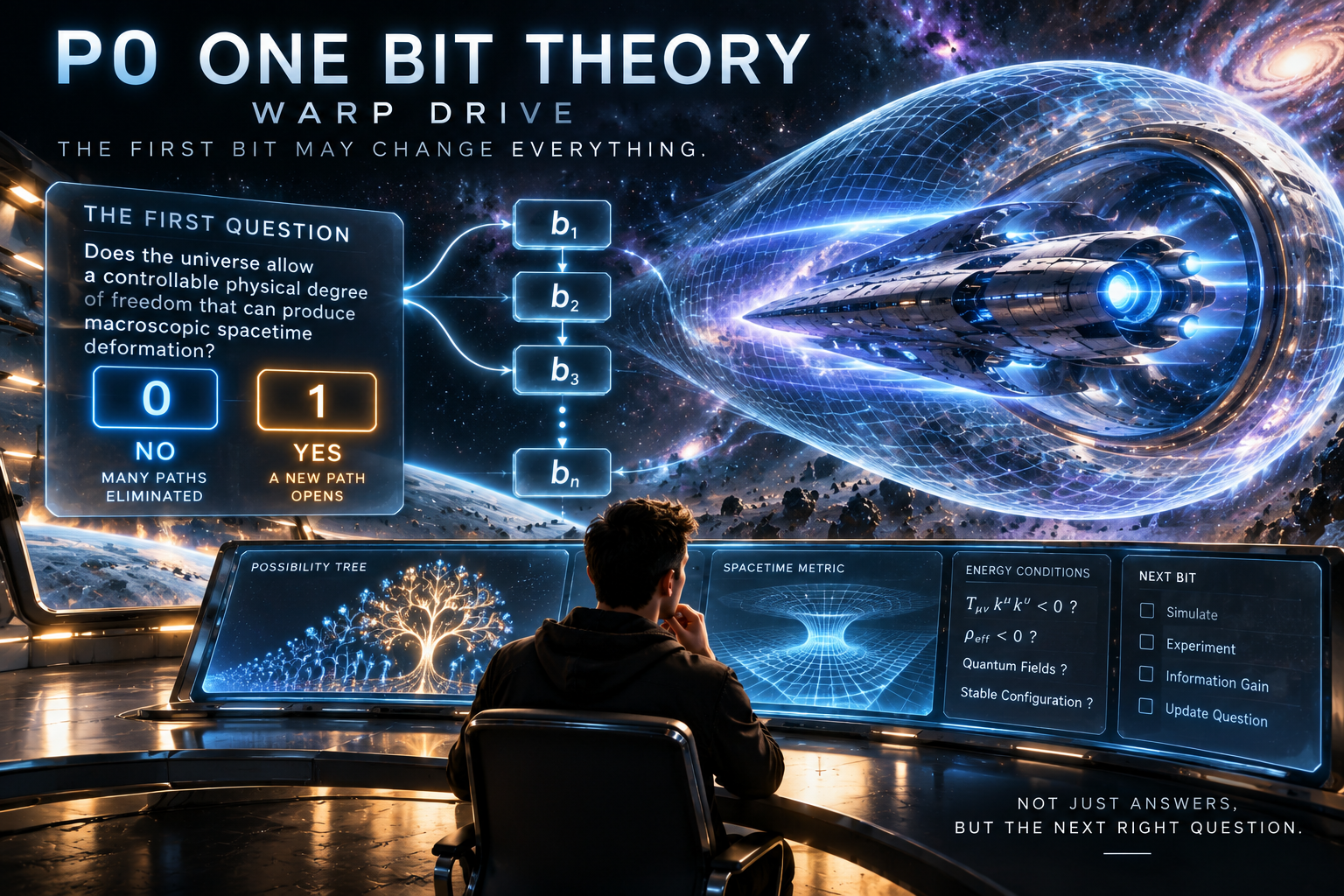
Q₀ = Can humans engineer effective FTL travel?
Under that question there may be billions of paths: new propulsion, spacetime metrics, negative energy, vacuum states, quantum gravity, extra dimensions, and phenomena that do not yet have a theoretical language. Ordinary research easily explores many of them at once. P0 asks which Yes/No can cut away the most wrong worlds in one step.
b* = arg maxb I(b ; Q)
The first question may not be “can negative energy be manufactured?” or “can the Alcubierre metric be engineered?” It may be a lower question:
Does nature contain a physical degree of freedom that is controllable, sustainable, and able to produce a macroscopic effect on spacetime geometry?
A large part of the technology tree can stop. There is no need to spend centuries on a direction this bit has already ruled out.
What matters changes at once. Ask the second question, then regenerate the next one from the new information gain.
Each bit regenerates the question with the largest remaining information gain: Q₀ → Q₁ → Q₂ → ⋯
What a civilization may lack is not only compute, more papers, or a stronger model. It is question selection: the ability to find, inside a nearly infinite unknown, the next question most worth checking.
If AI agents can later read physics papers, simulate hypotheses, design experiments, and compare information gain at the same time, the strongest use of AI for science may not be answer generation. It may be next-bit discovery: finding the next bit most worth asking of the universe.
The radical part of this idea is not a claim to know how to build a warp engine. It admits that we do not know, and asks something else: if the answer sits in a huge space of possibilities, is there a path of highest information efficiency that can approach it one step at a time?
Unknown → 1 bit → Less Unknown → 1 bit → ⋯
Science Fiction → Scientific Question → Experiment → Engineering
If this pressure test were actually started, the first mark on the board would not be an engine. It would be one sentence:
WHAT IS THE FIRST BIT?
What changes the path may not be the first answer. It may be the first question that was the right one to ask.
WE ARE IN THE LOOP.
Next
Not a search for a wormhole. A search for the first bit that would show the universe allows a channel to exist.