Planetary
Control energy, environment, and resources at the scale of a planet.
Home Research Lab P0 One Bit Theorem
P0 One Bit · Two Directions
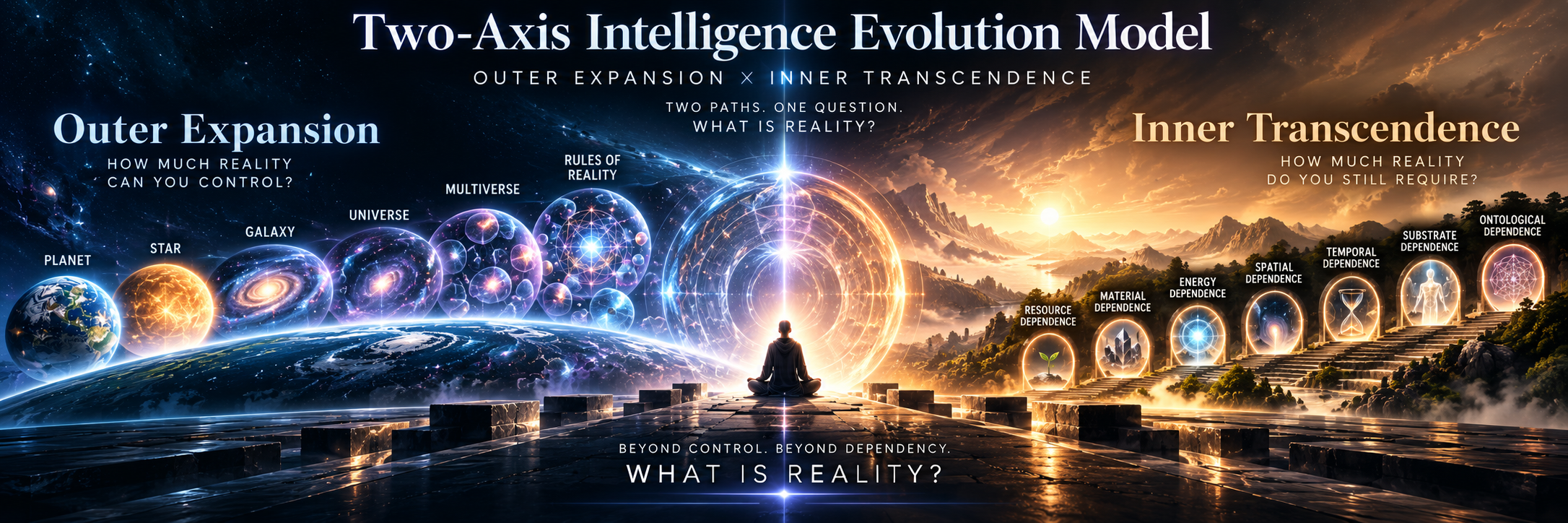
Civilization scales outward. Intelligence turns inward.
We usually imagine an advanced civilization in one way: how much can it control? That may describe only half of how intelligence evolves.
The familiar story
We usually imagine an advanced civilization in one way: how much can it control?
From the energy of one planet to the output of a star; from crossing a galaxy to engineering spacetime; then from cosmic engineering toward multiverses and the deeper rules of physics. This is a road of continual outward expansion.
Each step up gives a civilization a larger scale of control. That may describe only half of how intelligence evolves.
Path one
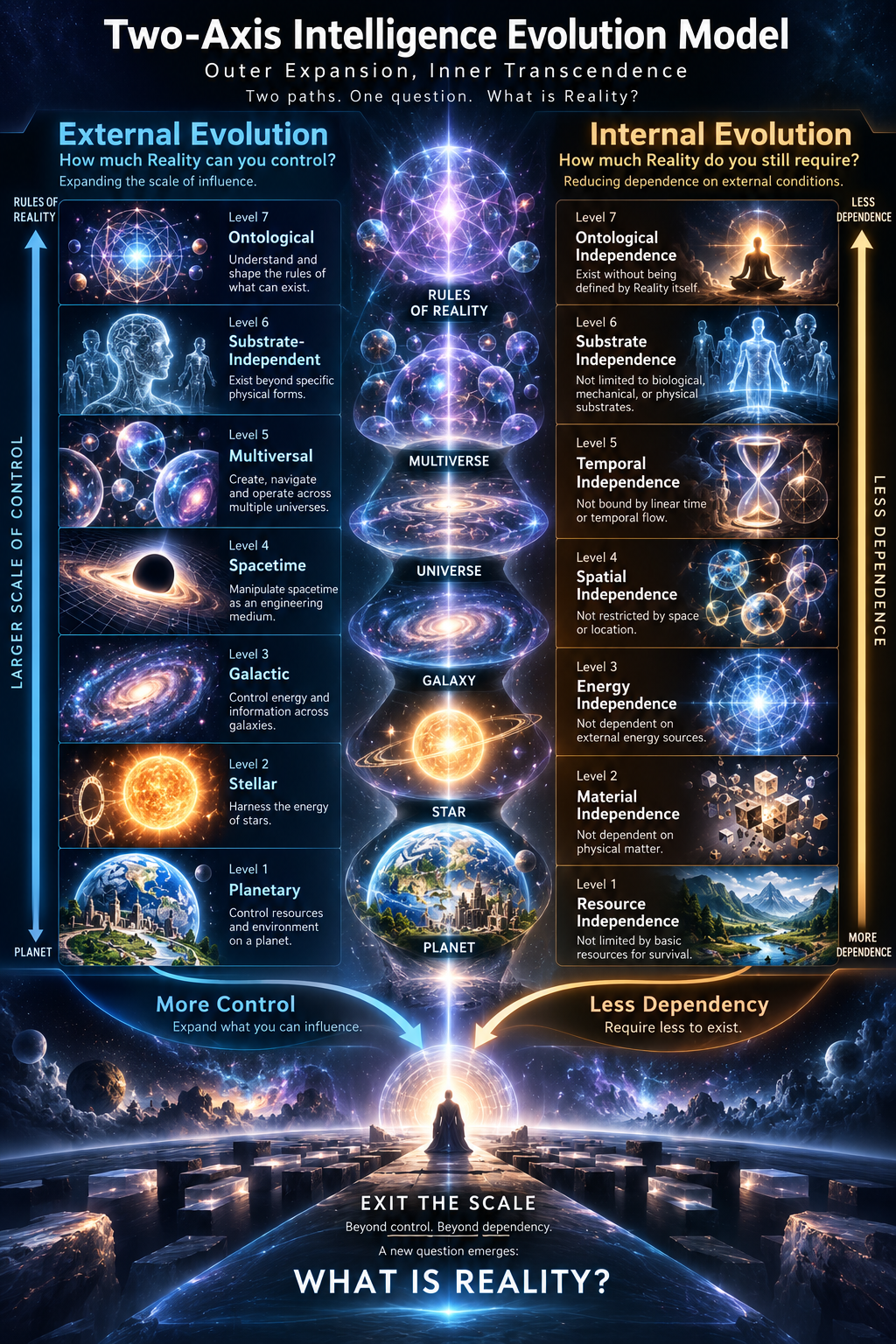
If a civilization keeps developing, it might break through in this order:
Control energy, environment, and resources at the scale of a planet.
Use the energy of a star, and no longer depend on a single planet.
Build energy and information networks across stars and across galaxies.
Spacetime is no longer only an environment. It becomes something that can be understood, modified, and engineered.
The civilization is no longer fully bound by the initial conditions and physical parameters of one universe.
Intelligence no longer has to depend on a particular biological body, chip, machine, or material structure. Information, cognition, and identity can continue across different carriers.
The highest question is no longer “how do we control the universe?” It is: What can exist? The civilization begins to understand, and even operate, the rules that generate Reality itself.
Path two
If the first path increases the power to control, another direction of intelligent evolution may run the other way: reduce your own dependence on external conditions.
A civilization might control an entire planet and still depend heavily on resources. It might control a star and still depend on energy. It might control a universe and still depend on spacetime. Even a civilization that can create universes may still depend on some deeper computational substrate or rule of existence.
Power and freedom are therefore two different variables.
Two axes
We can draw two evolutionary axes that do not reduce to each other:
External Evolution
This is the expansion of a civilization’s capability.
Internal Evolution
This is the decline of existential dependence.
The paradox
A striking paradox follows.
A civilization might already be able to create stars, reshape galaxies, manipulate black holes, modify spacetime, and even generate new universes. From the outside, it looks almost like a god.
But if it still needs some energy, computational substrate, spacetime, or underlying rule in order to exist, it is not yet free. It has only acquired a higher permission.
More control does not necessarily mean fewer constraints.
Beyond the scale
The real end of civilizational evolution may not be Type VIII, or Infinite Energy, or even Control Everything.
It may be a different question:
If intelligence can control Reality, can intelligence eventually exist without being defined by it?
If the answer is possible, the final step is not another Level upward. It is leaving the Level System.
Leave the ladder
This offers a model unlike the usual civilizational ladder:
Early civilizations seek resources.
Middle civilizations control energy.
High civilizations control information and spacetime.
The highest civilizations control the rules that generate Reality.
The last breakthrough may be this: control is no longer required. Once an intelligent system no longer depends on what it once tried to control, control itself loses its meaning.
Intelligence may therefore have two entirely different directions of evolution:
Civilization evolves outward by controlling more Reality. Intelligence evolves inward by requiring less Reality.
The ends of the two roads look opposite. One arrives at Everything can be controlled. The other arrives at Nothing needs to be controlled.
They may finally meet on the same question:
Mature intelligence may not be the master of Reality. It may be the intelligence that finally understands what the relation is, between itself and Reality.