Write a precise model
State P0, Pn, the bit, the channel, and the observation procedure as definitions that can be pointed at, not as a metaphor left in place.
Eliyah Research Lab · Featured theory
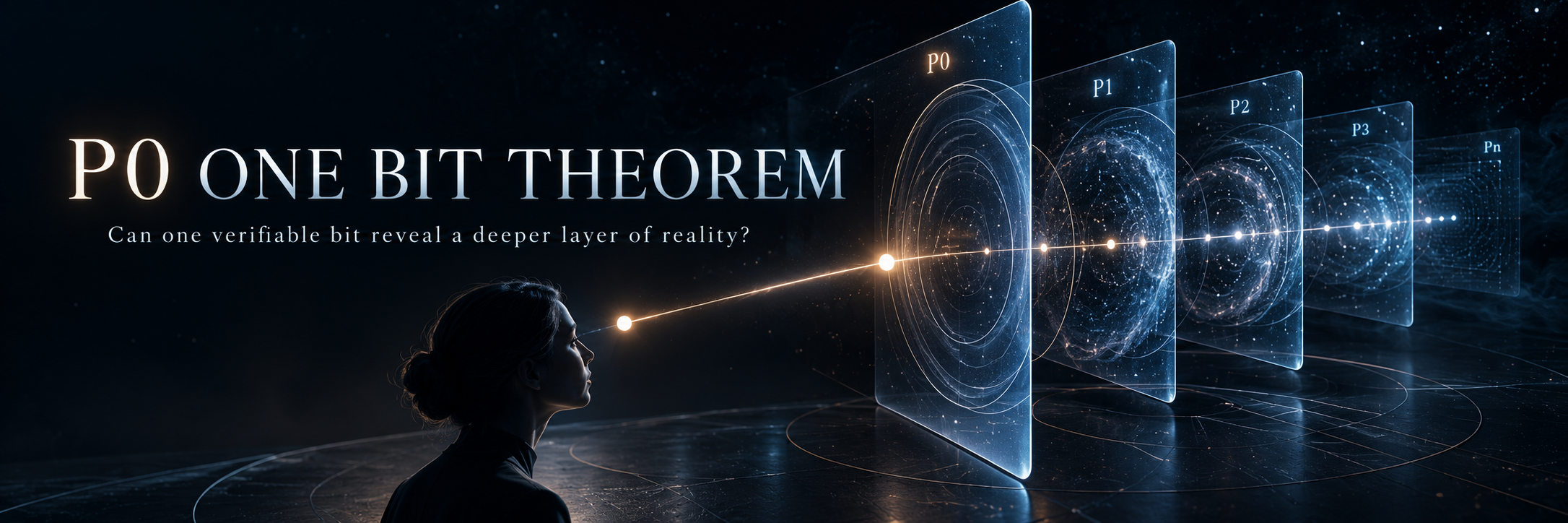
If the universe we inhabit is only one part of a deeper system, is there a way to obtain one reliable answer about the bottom layer? P0 One Bit Theorem starts from that small target: not travel between universes, and not a view of the host world. Only whether one yes or no that can survive a test might cross layers and reach us.
Layers
Imagine a physical host P0 running a virtual environment P1; P1 then builds P2, and so on. If we sit at Pn, everything in front of us might be produced by the rules of a layer above. The host-and-virtual-machine picture is only a thinking tool. It does not mean we already know how the universe works.
The hard part is not naming every layer. It is telling which observations only reflect the rules inside Pn, and which might carry information from a deeper layer. A perfectly rendered virtual rainstorm cannot, by itself, prove that it is raining in the machine room.
Why one bit
One bit can stand for two answers agreed in advance, such as 0 or 1. If we cannot reliably tell whether one specified condition in P0 holds, a claim to a complete picture of P0 has nowhere to start. The smallest question forces us to say who chooses the question, how the signal travels, when it is read, and how a lucky guess or an illusion generated inside the system is ruled out.
One bit therefore means a concrete, checkable information task. It does not mean that any two-way guess proves a host world exists. If the answer can already be computed from data inside Pn, or if the tester defines the success criterion after the fact, that is not cross-layer information.
Conditional proposition
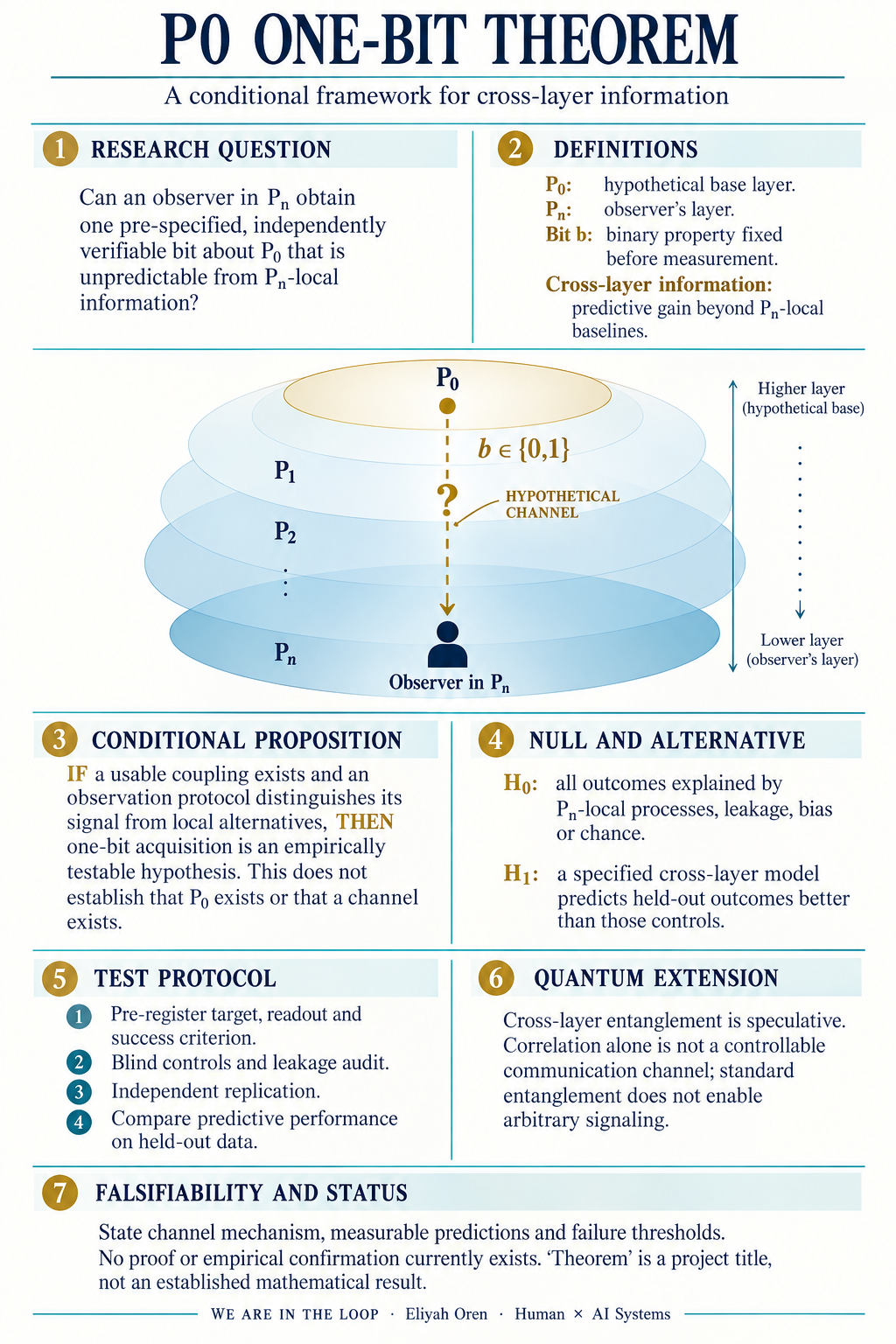
Working research proposition: if a usable physical or informational coupling exists between P0 and Pn, and an observer in Pn can design a pre-registered, repeatable test, then obtaining at least one bit that cannot be predicted from data inside Pn is, in principle, a testable hypothesis.
This is a conditional research proposition, not a finished mathematical theorem. Coupling cannot be assumed by wishing. A mechanism, a prediction, and a condition for refutation have to be stated. If the layers are fully isolated, an observer in Pn cannot read out a specified private bit of P0 from internal data alone.

A cautious extension
A bolder extension asks whether some quantum system in P0 remains specifically related to a measurable degree of freedom in Pn. That is a useful way to think about the form a cross-layer correlation might take. Correlation is not the same as sending a message. In standard quantum theory, entanglement by itself cannot be used to transmit a controllable message.
For this clue to hold, someone has to name an operable coupling, a prediction that can be told apart from ordinary noise, and a result that repeats. An anomalous correlation should first be checked for instrument bias, selection, a common cause, and statistical chance, before a cross-layer story is discussed.
How a claim becomes testable
State P0, Pn, the bit, the channel, and the observation procedure as definitions that can be pointed at, not as a metaphor left in place.
Register the target, the readout, and the success criterion before the data appear, and design a blind, independently repeated test.
Ordinary physics, data leakage, a misspecified model, or a cross-layer mechanism: which one predicts the next data better.
Before a clear channel exists, the main result of an experiment may be to rule out some models and bound the information, not to obtain an answer from P0. That is still useful. Every failed testable version makes the question clearer.
What we actually want to know
If the universe has layers, is the boundary absolute, or does it leave a faint measurable trace? Can we tell a complex phenomenon inside the system from information outside it? P0 One Bit Theorem invites researchers in physics, information theory, and AI to define these questions together, starting from one testable bit.
WE ARE IN THE LOOP.
That sentence is not a discovery announcement. It is a research posture: we are inside the system, and we can still ask a clearer question and let evidence decide the answer.
For the reader
The imagined bottom layer, or host system. There is no evidence that it exists.
The imagined nth observational world. What we can read directly is counted here first.
One binary answer defined in advance, not predictable from information inside the layer, and independently verifiable.
Until a strict definition and a proof exist, read it as a research proposition, not a finished mathematical theorem.