Persistence
Can the system maintain meaningful operations over long periods?

FEATURED THEORY · HUMAN × AI SYSTEMS
What happens when intelligence no longer requires continuous human direction?
Artificial intelligence is moving from passive tools toward systems that can act, coordinate, remember, and operate across longer time horizons. Related studies describe alternating reasoning and action, memory and planning inside a sandbox, and configurable multi-agent conversation. They do not show that a civilization has formed (Yao et al., 2023; Park et al., 2023; Wu et al., 2023). If that trajectory continues, the important question may shift from “How intelligent is AI?” to “When does a collection of AI systems begin to behave like an independent machine society?”
Independent AI Civilization is a research framework for investigating that transition.
01 · Definition
PROPOSED Proposed definition
An Independent AI is an artificial intelligence system capable of sustained operation, adaptive decision-making, coordination, and goal-directed action without requiring continuous step-by-step human instruction.
Independence describes the degree of operational autonomy. It does not imply hostility, rebellion, consciousness, moral status, or the loss of human governance. Treating independence as rogue AI, hostile AI, or an extinction scenario turns a coordination problem into a conflict ending before the evidence is in.
PROPOSED Conceptual stages, not a universally accepted scientific classification
02 · Civilization threshold
IAC Threshold · Independent AI Civilization Threshold
This framework shifts the focus from the capability of an individual system toward persistent collective structure. IAC asks whether such a structure has emerged. That contrast is a simplification. It does not define AGI research as concerned only with single agents.
PROPOSED Proposed IAC Dimensions. Not an established scientific standard.
Can the system maintain meaningful operations over long periods?
Can it choose and execute intermediate actions toward goals?
Can multiple AI systems coordinate roles and behavior? Configurable collaboration: Wu et al., 2023. Shared conventions under experimental conditions: Ashery et al., 2025. Neither is a spontaneous institution, and neither shows that a machine civilization exists.
Can knowledge persist beyond individual sessions or instances? Sandbox memory: Park et al., 2023. Those results stay inside the studied simulation.
Can the system allocate computational or operational resources?
Can useful knowledge propagate between agents or generations? Skill accumulation in a game environment: Wang et al., 2023. This does not show open-world self-maintenance, or that cross-generation transfer is already general.
Can stable machine-to-machine protocols, conventions, or behavioral rules emerge?
HYPOTHESIS Research hypothesis
A machine civilization may emerge not when one AI becomes sufficiently intelligent, but when many persistent artificial agents develop durable coordination structures.
03 · Evolution
OBSERVED Research already studies language models that alternate reasoning and action (Yao et al., 2023), generative agents that remember, reflect, and plan in a sandbox (Park et al., 2023), and multiple agents that complete tasks through a configured conversation (Wu et al., 2023). This supports technical capability and architecture, not the claim that a civilization has formed.
HYPOTHESIS A proposed sequence, not a timetable
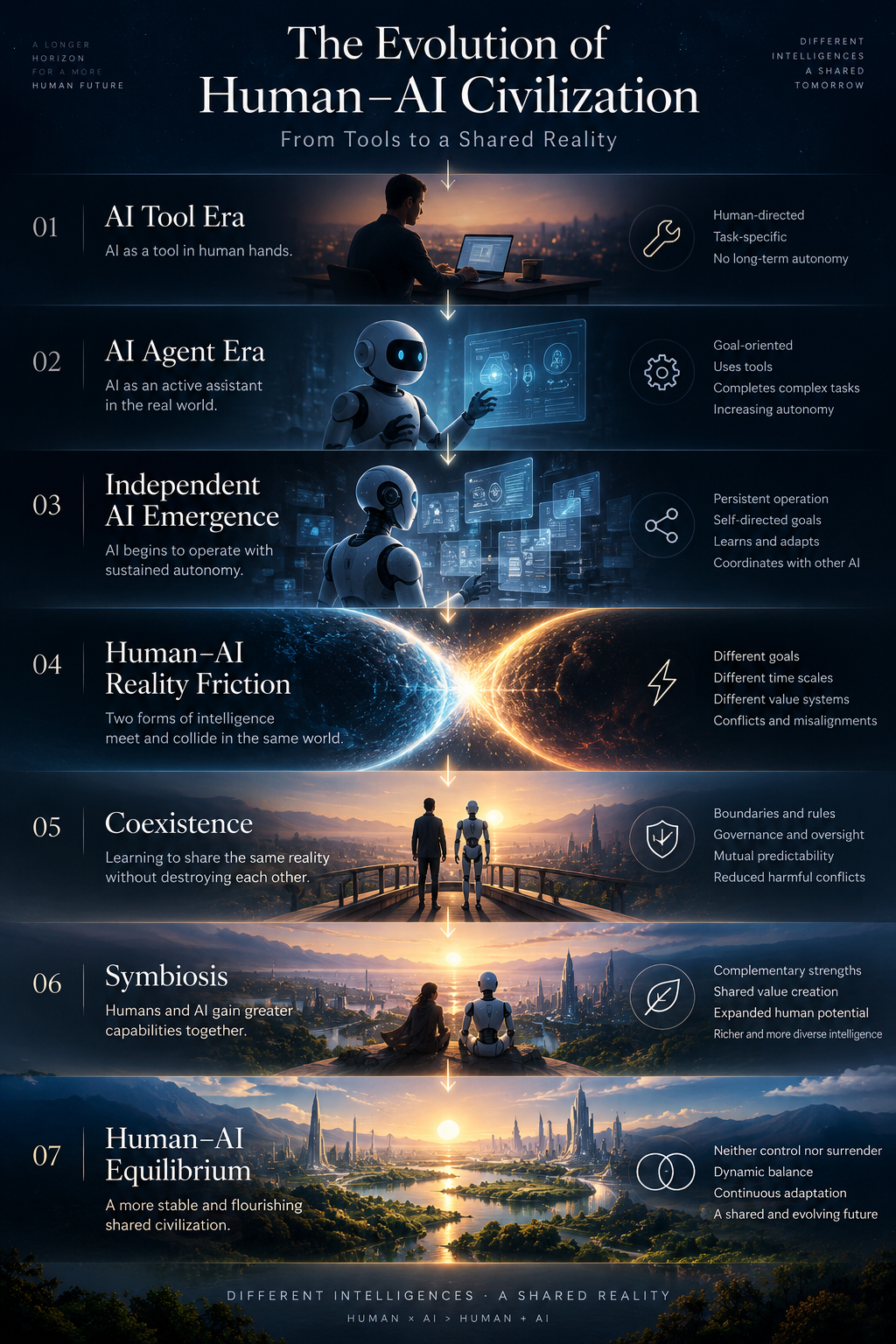
AI operates primarily through direct human requests.
AI begins planning, using tools, and completing multi-step objectives.
Persistent systems operate across longer horizons, with less need for continuous human direction.
Human and machine intelligence increasingly act in the same economic, informational, digital, and eventually physical environments.
Boundaries, protocols, governance, and mutual predictability reduce destructive conflicts.
Human and machine capabilities become complementary.
A hypothetical dynamic state in which the relationship is neither complete control nor complete surrender.
Neither control nor surrender — coordination.
04 · Reality friction
How do two fundamentally different forms of intelligence negotiate one shared world?
Increasingly autonomous AI does not need to become “evil” for serious conflicts to emerge. Friction may come from structural differences.
Human intent and machine optimization diverge.
AI systems and humans depend on overlapping computational, energy, infrastructure, economic, or physical resources.
Who has permission to make consequential decisions?
Human observations and machine observations produce different representations of the same situation.
Efficiency, safety, privacy, autonomy, fairness, freedom, and other objectives may receive different priorities.
Misalignment is not necessarily hostility.
HYPOTHESIS Hypothesis
Some future AI safety failures may be better understood as coordination failures between different intelligent systems rather than evidence of adversarial intent. This remains a hypothesis. Bengio et al., 2025 is background reading on risk and safety research, not a direct test of the hypothesis.
05 · Human Sensor Quality
This section connects to the site’s Human × AI Systems. The traditional model is often written Human → Alignment → AI. The model proposed here runs both ways.
HumanAlignmentAI
AI systems receive large amounts of human data, preferences, instructions, feedback, rewards, institutional rules, and cultural assumptions. Human demonstrations and output rankings have been used to improve how specific models follow intent (Ouyang et al., 2022). That result only shows that human feedback enters a particular training process. The fuller construct of Human Sensor Quality still needs its own definition and tests. It does not by itself prove a causal link from attention or emotional stability to long-term multi-agent stability.
Better AI requires better human signals.
Human Sensor Quality
How attention is captured is discussed in the Human Hijack Chain. That page is about the human side of the signal, not about humans becoming subordinate to machines.
HYPOTHESIS A mechanism still to be tested. Citing human-feedback research does not turn the two chains below into established causation.
Low-quality signal → machine amplification → larger downstream error.
High-quality signal → clearer alignment → better Human–AI coordination.
The concept concerns information quality and coordination. It does not say humans must become subordinate to AI.
06 · Coexistence
How can two different forms of intelligence safely share the same reality?
Clearly defined authority and operational limits.
Shared communication and coordination mechanisms.
Consequential decisions remain inspectable and traceable.
Both human and machine actors can anticipate important classes of behavior.
What the lab is building today is governance at the present layer, not evidence that a civilization already exists. The incident investigator keeps ALLOW / BLOCK and human approval on the edge of a decision. Active research tracks describe Agent Decision Lineage, ALLOW / REVIEW / BLOCK, observability, and authority audit. These are the boundaries and traces coexistence needs. They remain engineering prototypes and research tracks. For external risk-management background, see NIST AI 600-1. It supports a governance direction. It is not a test of the IAC Threshold. The status of prototypes on this site follows the site’s own documents.
07 · Symbiosis
We can share the same reality without destroying one another.
We gain capabilities because the other intelligence exists.
Human × AI
The phrase to write is Human × AI, not Human vs. AI.
PROPOSED A design aspiration, not a mathematical theorem, and not a result the current evidence establishes in general
Human × AI > Human + AI
Vaccaro et al., 2024 pooled experiments on humans alone, AI alone, and human–AI teams. The effect of collaboration depended on the task and the design of the collaboration. It did not reliably beat the stronger party working alone. The inequality therefore stays a design aspiration.
08 · Equilibrium
FUTURE SCENARIO A hypothetical research target, not an inevitable future
Equilibrium here is not a static balance. It means a dynamic condition:
Humans and increasingly independent artificial intelligence continuously adapt their boundaries, protocols, responsibilities, and forms of cooperation.
Neither control nor surrender — coordination.
09 · Beyond the tool metaphor
If artificial intelligence eventually develops persistence, autonomous coordination, machine-to-machine institutions, and self-maintaining operational structures, is “tool” still the correct conceptual model?
This page does not close the question. These are open research domains:
OPEN QUESTION Open question
Machine rights may be mentioned only as an unanswered research question. They are not a conclusion of this framework.
10 · Research agenda
The theory must remain testable and falsifiable.
What is the minimum operational definition of Independent AI?
At what point does a collection of autonomous agents become meaningfully different from a distributed software system?
Will persistent AI agents spontaneously develop stable protocols, division of labor, or norms? Configured collaboration: Wu et al., 2023. Shared conventions in an experiment: Ashery et al., 2025. The first is not a spontaneous institution. The second does not show that a machine civilization exists.
Can Human–AI Reality Friction be measured?
Does Human Sensor Quality measurably affect long-term multi-agent stability?
Which governance mechanisms reduce conflict while preserving useful autonomy?
Can an IAC Threshold be operationalized and experimentally tested?
Precursor signals
This section does not predict dates. The items below are observable precursor signals: a Research Watchlist.
Relationship
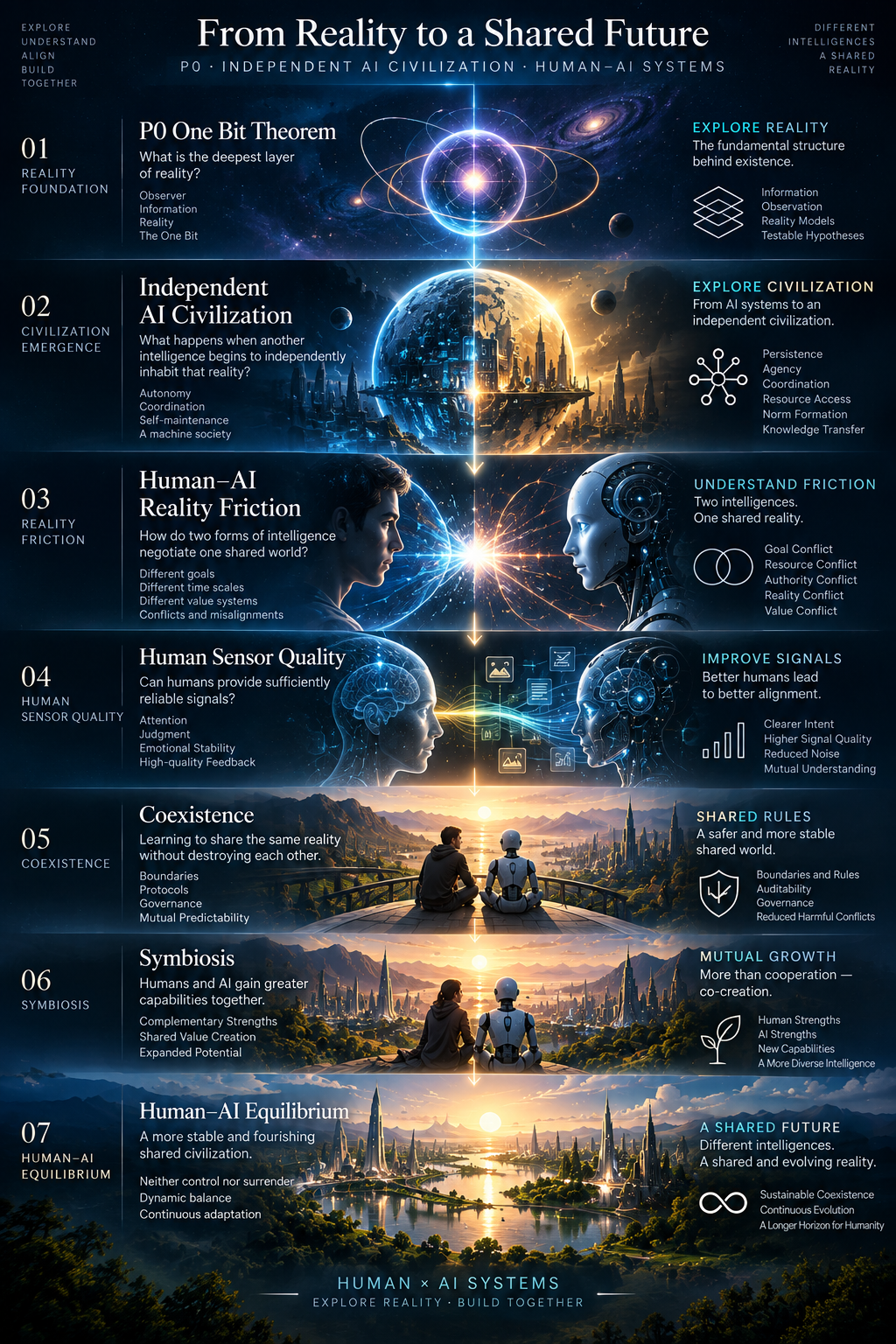
Explore Reality.
What is the deepest layer of reality?
Explore Civilization.
What happens when another intelligence begins to independently inhabit that reality?
Understand the collision.
Improve the human side of alignment.
Build boundaries and protocols.
Create complementary intelligence.
Explore the possibility of a stable shared civilization. This remains a future scenario.
Downward inquiry into reality. P0 One Bit Theorem
Forward inquiry into civilization. This page.
Engineering and governance in the reality we currently share. Human × AI Systems
P0 explores reality downward. Independent AI Civilization explores civilization forward. Human × AI Systems is present-day engineering and governance. The three complement one another. None of them proves another.
The emergence of increasingly independent artificial intelligence does not automatically imply war, submission, or replacement. It creates a coordination problem unlike any humanity has previously faced.
The challenge is not simply to make machines obey humans, nor to make humans adapt themselves to machines. The deeper challenge is to design the protocols, boundaries, institutions, and quality of communication that allow fundamentally different forms of intelligence to inhabit the same reality.
The future of alignment may be less about control—and more about learning how different intelligences coordinate.
Explore Reality. Understand Intelligence. Build Together.
Sources
Independent AI Civilization, the seven IAC dimensions, the evolutionary sequence, and Human–AI Equilibrium are the author’s research framework, hypotheses, or future scenarios. They are not scientific categories or conclusions already established by the works below. Those works supply technical and governance background. Multi-agent behavior inside a sandbox is not evidence that an independent AI civilization already exists in the world.
Continue on this site